Bleak house
Football supporters know something about disappointment. Yet maybe that's the point.

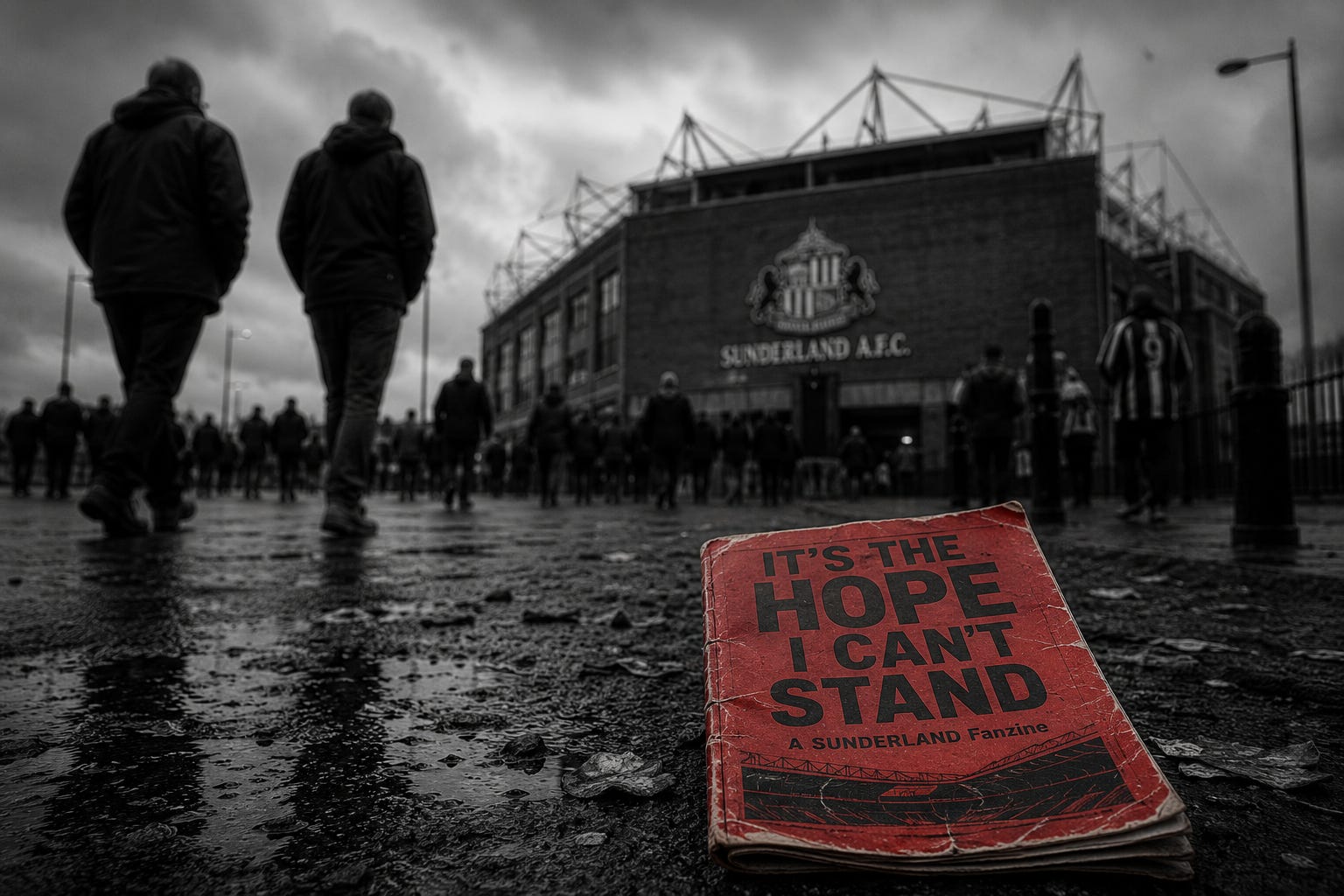
Years ago, Sunderland fans produced the wonderfully named fanzine It’s The Hope I Can’t Stand. Every supporter of every team and Nation understands exactly what that means.
The season begins with optimism. New signings arrive. Old problems appear solved. This year, surely, will be different. And then reality intervenes.
A missed penalty. A late equaliser. A new manager mid-season. A season that ends not with triumph but with a familiar shrug of resignation. Indeed, football fans may be among the world’s foremost experts in disappointment. Yet despite this, we keep turning up.
And as we work through the group stages of the football World Cup, it strikes me that we don’t avoid disappointment. To the contrary, we accept it as part of the arrangement, and that got me thinking.
Own goal
By the time we reach midlife, most of us have accumulated our own collection of missed penalties. Not necessarily dramatic failures. More often, they’re small disappointments that never fully register in our consciousness. The relationship that changed. The business idea that never quite took off. The version of ourselves we expected to become by now.
When I was young, I imagined life as a steady ascent. The benefit of hindsight suggests something rather different. Life, or so it seems to me, turns out to be a negotiation between hope and reality. And perhaps that’s no bad thing.
The gift
One of the peculiar “gifts” of disappointment is that it reveals where we’ve invested our expectations. When something hurts, it’s often because it mattered. The pain has something to tell us. Sometimes disappointment reveals a genuine loss. Sometimes it reveals an attachment. Sometimes it exposes an assumption we didn’t even realise we were carrying.
I remember speaking to a man who had recently retired. For decades he had looked forward to this moment. No more alarms. No more deadlines. Freedom at last. Yet six months later he found himself strangely adrift.
The disappointment he felt wasn’t really about retirement. It was about discovering how much of his identity had been wrapped up in being needed. The thing he thought he wanted had revealed something deeper.
Life has a habit of doing that. We imagine that happiness lies just beyond the next achievement, the next purchase, the next milestone. Then we arrive and discover that the destination feels remarkably similar to where we started. Not worse, just not quite what we imagined.
The pursuit of happiness
The comedian Jimmy Carr uses a form of mathematical framing when he says that happiness is your current situation minus expectations. He uses it to explain why our emotional state is often dictated by the gap between reality and what we believe should happen. When expectations exceed reality, we experience disappointment. When reality meets or exceeds expectations, we feel content.
The older I get, the more I suspect that disappointment isn’t always evidence that life has gone wrong. Sometimes it’s evidence that our understanding is becoming more realistic, and sometimes reveals a deeper invitation.
Count your blessings
The dreams of youth are often beautifully simple. Reality is usually more complicated. The perfect career becomes meaningful work. The perfect marriage becomes a real relationship between two imperfect people. The perfect future becomes an ordinary Tuesday afternoon that, if we’re paying attention, contains more blessings than we once knew how to see.
None of this is an argument against ambition or hope. Hope remains essential, for without hope we’d never begin anything worthwhile. But perhaps maturity involves holding our hopes more lightly, pursuing them wholeheartedly whilst recognising that they may not unfold exactly as planned.
The real danger is not disappointment itself. The danger is allowing disappointment to become our permanent address. We’ve all encountered people who never quite moved on from an old grievance, an old betrayal or an old setback. The disappointment became part of their identity. Life narrowed around it.
Yet others seem to experience disappointment differently. They absorb it, learn from it and somehow emerge with a broader perspective than before. No hardening, no trace of bitterness, just a little wisdom.
Like football supporters gathering once again at the start of a new season, I understand that disappointment is not the opposite of hope. It is often the price of hope. And perhaps that’s why it has something valuable to teach us.
The unbearable light
The question, therefore, is not whether disappointment will visit us. It will. The question is whether, when it arrives, we allow it to close us down or open us up. Whether it leaves us resentful for what didn’t happen or grateful for what remains. Whether it teaches us to abandon hope or simply to place it on sturdier foundations.
When we feel disappointment, it might indicate where we have placed our trust in things that were never able to offer lasting reward. This feels particularly relevant as I navigate midlife, and I use these moments to reflect on where I am placing my trust, and where a deeper, more lasting satisfaction might be found. It informs my decision-making.
These days, the more I suspect that some of life’s most important lessons arrive disguised as things we never wanted. Disappointment may be one of them.